Session 6: Year 8, WeeK 25 In Review
Experimenting, Designing, and Growing: A Week Across Our Studios
spark studio
The Week in Spark: Growing Responsibility
This week in Spark, we continued exploring our year’s overarching question: “How is the world changing and how will I grow myself up in it?” Our focus has been on responsibility—especially understanding cause and effect, a fact vs. a claim, as well as learning to take ownership of our actions. These are important steps in becoming thoughtful learners and responsible scientists.
Throughout the week, learners practiced our Rules of Engagement as they worked to grow into responsible scientists. Each day we challenged ourselves to stay focused, listen carefully, and persevere through difficult tasks. We also continued strengthening our skills in math, language, and handwriting. Discovering what it takes to carry these responsibilities is exciting work—it can be challenging, but it is also a lot of fun.
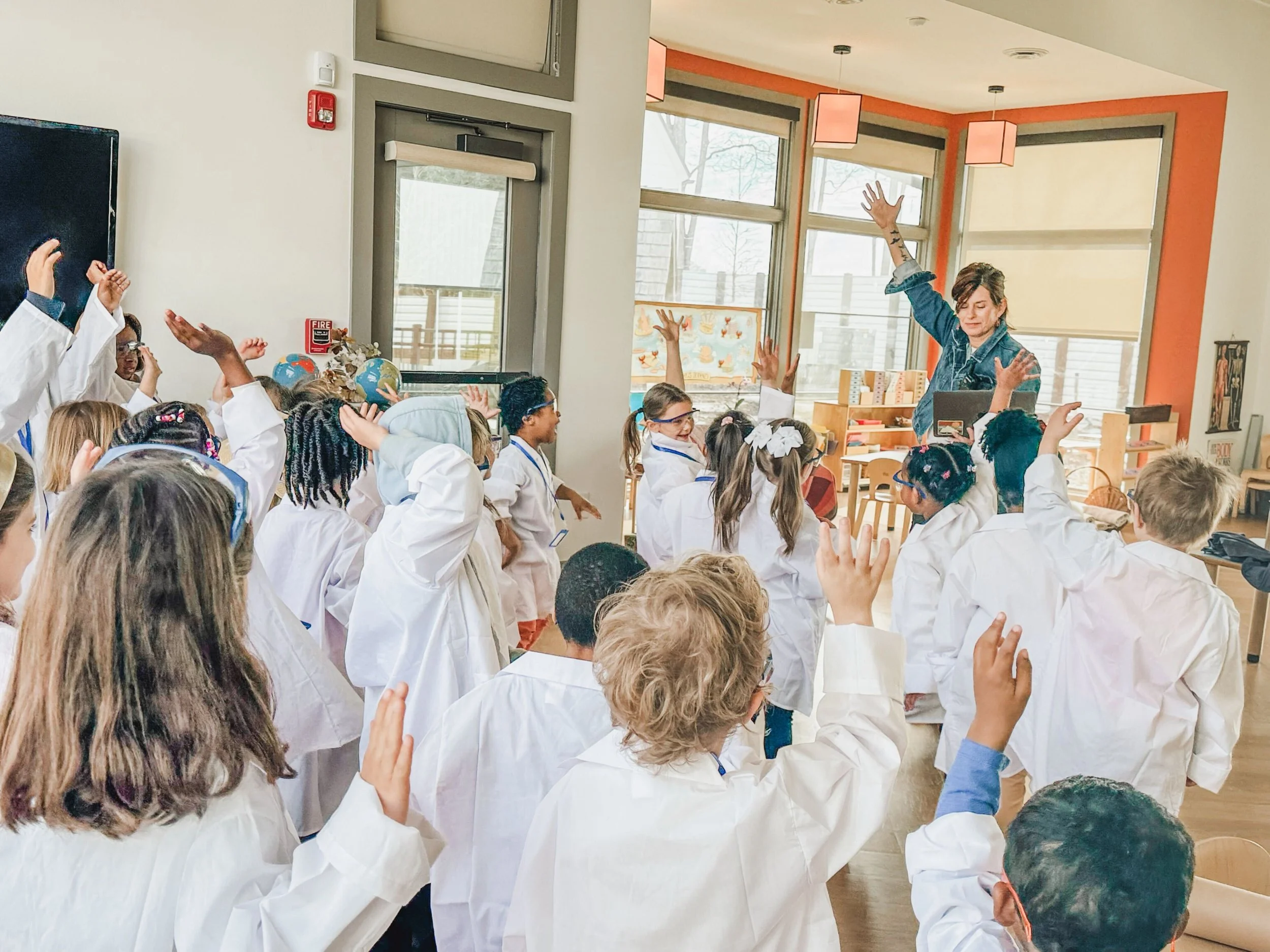
Our first group of responsible leaders stepped into the lab to observe what it’s like to conduct research. They practiced noticing details, asking questions, and respecting the learning environment. After observing, the following day, all of Spark was invited to begin a hands-on candle-making chemistry experience with our very own expert, Ms. Ivana. This activity required careful measuring, mixing, pouring, and—most importantly—following safety procedures. It was a wonderful opportunity to practice responsibility while learning real scientific processes.
In PE, the courtyard was filled with exhilarating obstacle courses that kept us moving, climbing, and racing with excitement. Everyone had fun challenging themselves and cheering on their Studio mates as they made it through each obstacle. In art, we learned about cubism by studying the work of Pablo Picasso. We practiced the style by creating our own cubist self-portraits with different shapes and angles. When we finished, we all looked so funny and unique!
As we continue our journey in the Spark Studio, learners will keep practicing perseverance and responsibility so they can grow into respectable and capable leaders.
We are also looking forward to meeting with each of you during our upcoming conferences. You can sign up here. Learners will participate and share what they have been discovering and learning in the Studio.
The letter for the week of March 9–13 is: “E”.
A good practice at home to incorporate into the share each week is writing both the uppercase and lowercase letter with proper pincer grasp and formation.
lower elementary studio
Session 6 is officially fizzing with energy! As we step into this next stretch of the school year, our Studio is bubbling with intentionality, focus, and a renewed commitment to ownership.
In Civilization, we explored Mayan mathematics, including the invention of the number zero, a groundbreaking concept that transformed how civilizations understood quantity and place value. Learners are studying the Maya’s base-20 number system and their highly accurate calendar used to track time. Through hands-on practice writing Mayan numerals, learners are discovering how mathematical systems reflect a civilization’s culture, priorities, and innovation.
In Quest, thank you to Mrs. Barbee for serving as our Expert Guest. During her visit, she demonstrated an alternative method for creating Coca-Cola using carbonated water and raspberry balsamic vinegar. She also introduced key scientific concepts such as solvents, solutions, suspensions, and colloids, which prepared learners for our World of Coca-Cola field trip. The science behind carbonation and mixtures is coming to life as learners prepare to design their own soda-inspired creations for Exhibition.
In Story Arts, learners analyzed Audience Impact as part of their persuasive writing pitch. Before revising, they were challenged to clearly define their target audience and consider what that audience values, fears, and hopes for. Learners then justified three specific revision choices using evidence grounded in audience psychology, industry standards, or comparable professional examples.
As a Studio, we are continuing to strengthen our productive struggle through DRIP, which stands for Desire, Resourcefulness, Initiative, and Persistence. We have noticed that many learners are still growing in the areas of Persistence and Initiative. When work feels challenging or unclear, some learners are quick to seek help before fully attempting solutions on their own or pushing through initial frustration.
We are coaching them to first:
Try multiple strategies
Use available resources
Collaborate with their Studio mates
before turning to the Guides. Learning to rely on one another builds problem-solving skills, confidence, and community, while helping learners recognize that struggle is a normal and valuable part of growth.
Starting this week, we will begin including a Question of the Week to intentionally connect our learning at school with meaningful conversations at home. These questions are designed to help learners reflect more deeply on our Overarching Question and practice growing themselves up in thoughtful, real-world ways.
Question of the Week
When something does not go the way you hoped, how can choosing to take full responsibility change the outcome and help you grow into the kind of person the changing world needs?
Thank you for partnering with us as we help learners build both fizz and focus. We look forward to seeing everyone on Tuesday, March 17 for Learner-Led Conferences. It is sure to be a sparkling celebration of progress!
upper elementary studio
Choices, Creation, and Big Questions
The second week of Session 6 has been full of creative energy as learners prepare for the upcoming Story Arts play. At this early point in the session, many learners are working in the Explore modality—trying new things, observing closely, and learning how artists and storytellers make intentional decisions.
One of our big discoveries this week came from watching short acting clips together. As we analyzed the scenes, learners began to notice something important: nothing an actor does on stage is accidental. Every movement, pause, tone of voice, and facial expression is a choice. Once learners began to see acting through this lens, the performances they watched looked very different. Instead of simply seeing characters, they began seeing the decisions actors make to bring a story to life.
Painting the World of the Play
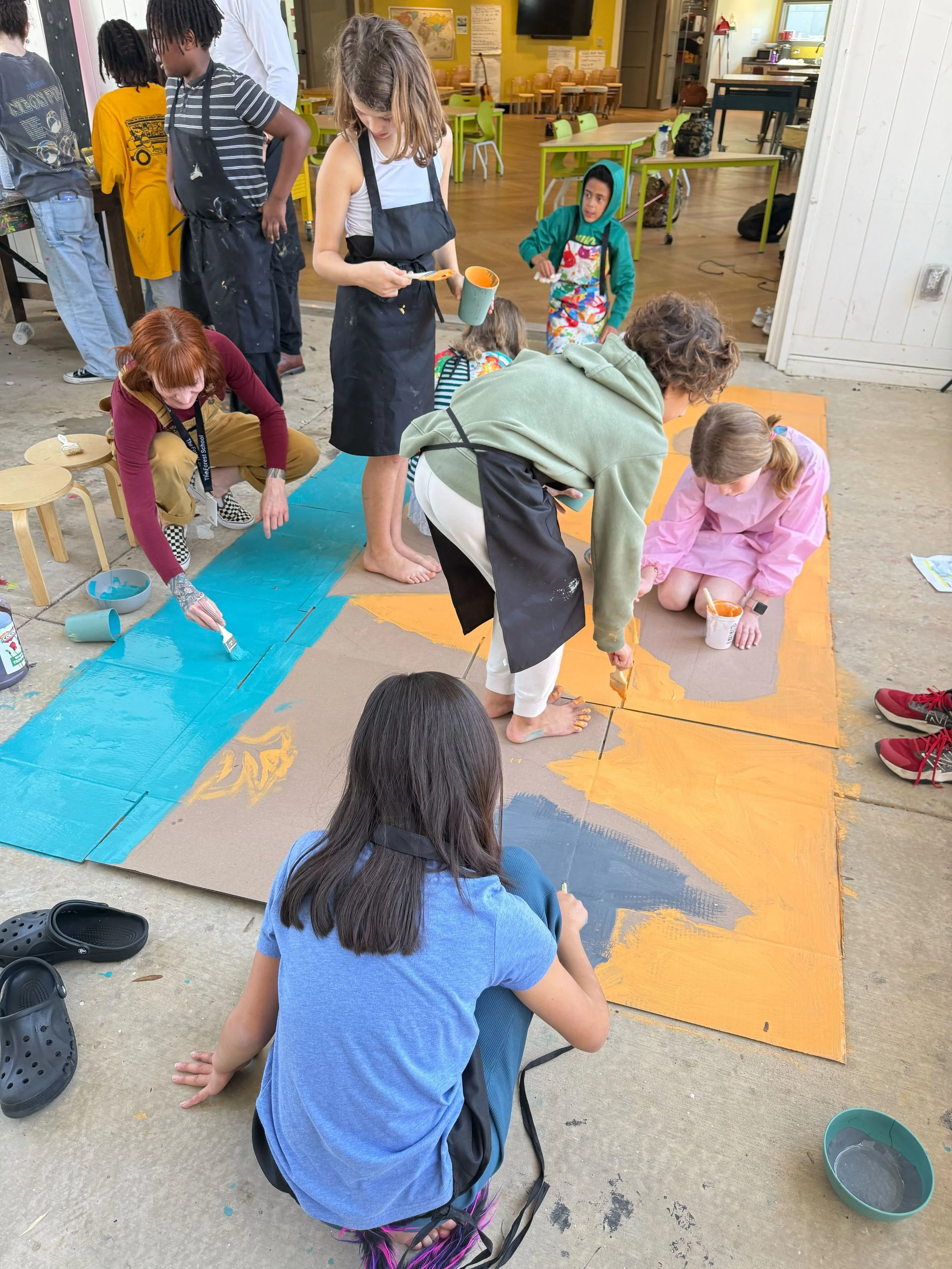
The Studio also came together for a special double art block to begin work on our three main periaktoi backdrops. These rotating triangular set pieces will help transform the stage into different locations throughout the play.
The designs were created by Dottie and Mika, and the entire Studio joined in to bring them to life with paint. Our art Guide, Ms. Amanda, led the effort, helping to sketch and scale the original drawings up to full size on the large panels. Watching the Studio collaborate on something this big was exciting—brushes moving, colors mixing, and ideas coming together into a shared visual world.
Meanwhile, members of the design team tackled a very different kind of project. They carefully took apart two old televisions to salvage electronic components that might be used in building our mecha-dragon prop. It was a mix of engineering curiosity and creative problem-solving.
Building Stronger Stories
Alongside the work for the play, every learner continued developing their own original story.
This week we focused closely on the inciting incident, often called the Call to Adventure in the Hero’s Journey. Learners explored how this moment usually happens to the character, not because of the character.
A hero might:
Get injured
Discover a mysterious object
Learn about a competition
Stumble into a dangerous situation
Only after this event does the character make an important decision: to pursue a goal. That decision launches the story into Act 2.
Understanding these structural elements takes time. The hope is that by the end of the session, learners will not only recognize these patterns but also use them naturally in their own storytelling.
Quest: Designing Sensory Instruments
Quest work also moved into a new phase this week as learners began prototyping sensory instruments.
Working in groups of four, each team tackled one of the four design challenges presented by our expert collaborator, music therapist Maria Aguilar. The goal is to create instruments that can help stimulate the brain through rhythm, sound, or tactile interaction.
Teams presented their initial designs and checked them against a rubric to see whether they met the key requirements. Once their designs were approved, they began the next stage—actually building the prototypes.
At this point the learning becomes very real. Materials are in hand, designs must function, and collaboration becomes essential. The increased engagement across the Studio this week showed just how motivating that shift can be.
Thinking Carefully About AI
We also spent time having thoughtful conversations about artificial intelligence.
The world is changing rapidly. Technologies like self-improving AI systems and robotics are advancing quickly, and learners were curious to explore what these changes might mean.
But just as important as understanding the technology itself is deciding how we personally use it.
As a Studio, we are beginning the process of determining our own shared expectations and policies around AI use. Learners raised thoughtful questions:
Is it okay for AI to help check grammar?
What about outlining?
When does AI support learning, and when does it replace the learning process?
One learner offered a particularly thoughtful perspective:
If AI gives feedback and we incorporate it ourselves, we actually learn. But if it does the work for us, then we don’t.
These are exactly the kinds of questions that thoughtful communities need to wrestle with. By discussing them openly and carefully, learners are practicing something very important—taking responsibility for the tools they use and the choices they make.
As Session 6 continues, the Studio is moving from exploration toward deeper creation. Sets are being built, stories are taking shape, instruments are being designed, and big questions about the future are being asked.
There is a lot ahead—but the momentum is building.
Learner-Led Conferences are on March 17!
Mr. K and Mr. Hadrian will be splitting conferences this time so they can all occur on that day. Please email us to let us know any particulars about what you'd like to discuss.
middle school studio
A Week of Experimentation, History, and Creative Design in Middle School
This week in the Middle School Studio was full of experimentation, analysis, and creativity as learners engaged in hands-on science, historical investigation, and artistic design.
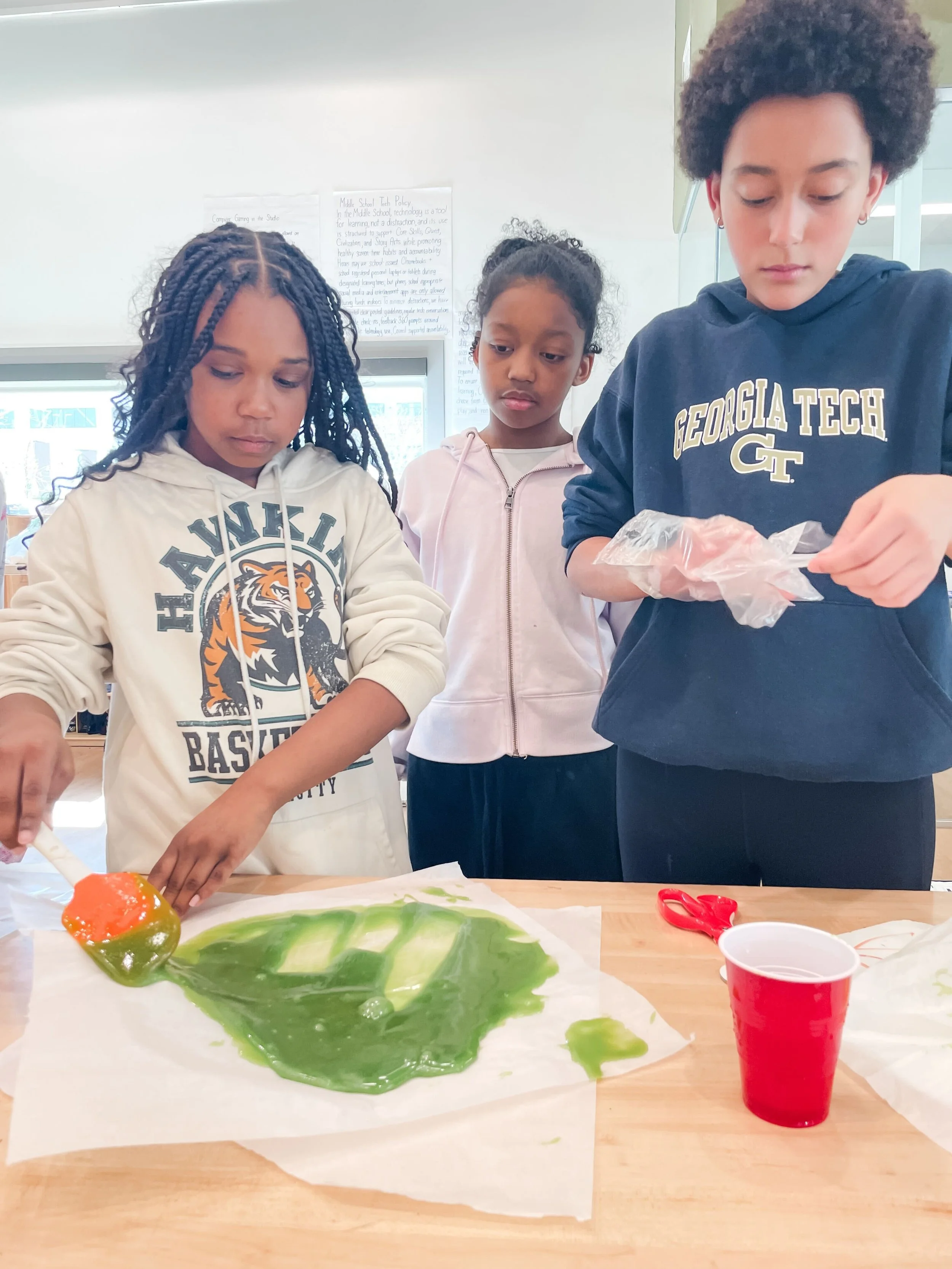
In Quest, learners began the first round of experimentation for our current challenge by making saltwater taffy and candied apples. These weren’t just cooking activities—they were scientific experiments. Learners carefully measured ingredients, observed texture changes, and began thinking critically about how factors like temperature, sugar concentration, and humidity affect candy-making.
After completing their first round of trials, learners took on the role of real scientists by writing their first formal Lab Report. They documented their procedures, observations, and early hypotheses about how they might improve their recipes in future experiments. Learning how to record and analyze results is a critical part of the scientific process, and this was an important step toward preparing for the next phase of testing and iteration.
In Civilization, learners explored a pivotal moment in medieval history: the speech given by Pope Urban II at the Council of Clermont in 1095, which helped launch the First Crusade. Working in small groups, learners closely analyzed a historical version of the speech to separate facts, opinions, and evidence. They also discussed the intended audience and why such a message might have been persuasive at the time.
After their initial analysis, learners researched how Europeans responded to the Pope’s call and what happened during the early stages of the First Crusade. To demonstrate their understanding, groups created maps and timelines highlighting key early events. The discussion portion of the challenge pushed learners to wrestle with a complex question that still resonates today: if a political or cultural conflict has lasted for centuries, is it possible to truly resolve it—and whose voices should be included in that process?
In Story Arts, learners began exploring the world of 3D modeling and character design, looking at how professional artists create characters for films, games, and animation. The launch sparked discussion about careers in animation and visual effects and whether most viewers realize how much design work goes into the characters they see on screen.
Learners studied how professional designers use geometric shapes, silhouettes, and contrast to create memorable characters. Using these techniques, each learner began designing their own character. They started with rough sketches, broke their designs down into basic shapes, and then refined their characters with contrasting forms and color.
By the end of the challenge, learners had not only produced their own concept sketches but also reflected on how professional design strategies influenced their creative choices.
From candy chemistry to medieval history to character design, this week showcased the power of learning by doing—where experimentation, analysis, and creativity all come together in meaningful ways.
Reminder: Look for a Hero-led Conference sign-up email soon. Conferences will be held March 17–20.
high school studio
This week our learners wrapped up an incredible Story Arts experience exploring the world of American Sign Language (ASL). Throughout the session, heroes practiced communicating through signs, facial expressions, and body language while also learning about Deaf culture and the importance of accessibility in communities.
To close out the experience, learners took on a meaningful final challenge: helping make The Forest School a more deaf-friendly community. Heroes worked together to label items throughout the Studios across campus using ASL and visual identifiers. This project helped them apply what they learned while creating something that will continue to benefit others in our community.
It was powerful to see learners realize that communication is not just about speaking—it’s about making sure everyone can belong and participate.
Looking Ahead: Quest Begins Next Week
Quest: The World & Chemistry of Hair
In this hands-on scientific exploration, learners will dive into questions like:
Why does hair behave differently for different people?
What causes dryness, breakage, or oil balance?
How do real hair products work chemically?
Could we design something that works better in the real world?
Learners will explore the science and chemistry behind hair, analyze real product ingredients, and experiment with creating solutions that could work for all hair types and textures. This Quest will blend chemistry, research, and real-world problem-solving as heroes investigate how science connects to everyday life.
Core Skills & Hero Requests
As always, we continue protecting focused time each day for Core Skills, ensuring learners are making steady progress in reading, writing, and math.
Heroes are also continuing to submit Hero Requests, collaborate with their running partners, and reflect on their work as they move through their badges and challenges.
Thursdays remain our dedicated time to review badge submissions and approve completed work, helping learners celebrate progress and stay accountable to their goals.
Ongoing Check-Ins
Guides continue holding regular check-ins with learners to support goal setting, progress tracking, and reflection. These conversations help heroes take ownership of their learning journey while identifying areas where they want to grow.
One of the most powerful moments this week came from watching learners realize that small actions—like labeling spaces for accessibility—can make a community more welcoming for everyone. That mindset of empathy and real-world impact is exactly what we hope to cultivate.